

The Real Cost of Owning an Older Home in Southwest Austin
Buying an older home in Southwest Austin can absolutely be worth it. Some of my favorite neighborhoods are full of homes built in the 70s, 80s and 90s. The tradeoff is that you're probably going to update things as you go, or renovate the house and own it long enough for those improvements to make financial sense. I generally tell buyers not to assume they're going to put $100,000 into a house and immediately create $100,000 in equity. In many cases, you need to enjoy the improvements yourself and give the market five or ten years to catch up.
So what does renovating an older Austin home actually cost? Don't hold me to these numbers exactly. I'm constantly negotiating repairs and working with vendors through real estate transactions, so these are ballpark numbers based on what I've been seeing. Contractor pricing can vary dramatically, and I've even seen what I call a "neighborhood premium." A project quoted at $30,000 in Maple Run might suddenly be $50,000 for a similar scope in Circle C. That's why getting multiple bids matters. These also aren't wholesale contractor prices. If you own a construction company or have established trades, you may be able to do the same work substantially cheaper.

Should You Renovate Before Selling Your Austin Home?
Five years ago, fresh paint, new carpet and a few cosmetic updates could make a house feel renovated. Today, those things don't necessarily command a premium. In many parts of the Austin housing market, buyers simply expect a home to be clean, maintained and move-in ready. When buyers have significantly more inventory to choose from, torn-up flooring, beat-up walls and obvious deferred maintenance aren't things they have to overlook anymore. They can just go see the next house.

Why Isn’t My Austin House Selling?
How times have changed. A few years ago, you could put a house on the market with a handful of iPhone photos and have six offers by the end of the weekend. Today, a fully staged home with professional photography, video, and what appears to be a reasonable asking price can still sit on the market for three months. So when a seller asks me, “Why isn’t my Austin house selling?” the answer isn't always as simple as lowering the price.

How’s the Austin Real Estate Market? It Depends Who’s Asking.
“How’s the market?” is probably the question I get asked more than any other when someone finds out I’m a Realtor. The problem is there really isn’t one answer. The real estate market is constantly moving between favoring sellers, being relatively balanced, and favoring buyers. One of the primary ways we measure that is months of inventory. Basically, if no additional homes came on the market, how long would it take buyers to purchase everything currently available based on the existing pace of sales? Lower inventory generally favors sellers. As inventory grows, negotiating power begins shifting toward buyers.

78749 Real Estate Market Update: What the Last 90 Days Tell Us
The 78749 housing market continues to be one of the more interesting markets in Southwest Austin. Looking at everything currently active, under contract and pending, along with the 113 homes that closed over the last 90 days, the market isn't necessarily slow—it's selective. The median closed price was $575,000, while the average was about $588,000. Closed homes sold for an average of 98.7% of their list price, so buyers are getting some negotiating room, but we're definitely not seeing sellers universally give their houses away.
AISD Boundary Changes Delayed Again: What South Austin Homeowners Should Know
If you've been following the Austin ISD boundary changes with me, we have another update and this one gives South Austin homeowners a little more breathing room. AISD was originally supposed to release its recommended Phase 1 boundary changes by August 7, but the district has pushed that timeline back again. AISD says it wants to wait until school starts so it can see actual enrollment numbers following recent school closures and the new transportation changes rather than making decisions based on summer projections. Phase 1 recommendations are now expected in September, with a Board vote anticipated in October.
The biggest takeaway for South Austin is that AISD continues to narrow what it considers an urgent boundary change. Phase 1 is now focused specifically on schools facing severe overcrowding for the 2027-28 school year, along with establishing the new attendance area for Marshall Middle School. Most of the larger changes we've been talking about including feeder-pattern changes and attempts to redistribute students between schools with very different enrollment levels are being pushed into Phase 2. That process begins in 2027, with the broader changes currently expected to take effect for the 2028-29 school year.

The Mortgage Mistake That Could Cost You Your Earnest Money
One of the biggest misconceptions I see is that all mortgage lenders are basically the same. Just like real estate agents, that couldn't be further from the truth. Over my 11 years in real estate, I've never had a client lose their earnest money deposit. There have been a few close calls, though, and almost every one of them had one thing in common: the lender stopped communicating or failed to identify a financing issue early enough for us to solve it.

Why Tree Trimming Matters Before Selling Your Home in Austin
When most people think about preparing their home for sale, they focus on paint, landscaping, and decluttering the inside. One thing that often gets overlooked is the trees. In Austin, tree maintenance isn't just about curb appeal, it's also about timing. If you own Live Oaks, Red Oaks, or protected heritage trees, spring isn't always the best time to trim them. That's because pruning during the spring increases the risk of Oak Wilt, a disease that can spread quickly through healthy oak trees. In general, arborists recommend trimming oak trees between July and January, when the risk of transmission is much lower.

Will Interest Rates Fall Before the End of the Year?
One of the questions I get asked more than almost any other is, "Should I wait for interest rates to come down?" The honest answer is... nobody knows for sure. The Federal Reserve has made it clear that inflation remains its biggest concern, and as long as inflation stays elevated, interest rates are likely to remain higher than many buyers would like. Financial markets continue to adjust their expectations almost daily based on new inflation reports, employment data, energy prices, and global events.
Over the past month, inflation showed one of its largest declines in quite some time, which was certainly encouraging. Much of that improvement has been attributed to lower energy prices after tensions in the Middle East temporarily eased. Since then, however, oil prices have become more volatile again as conflict with Iran has resurfaced, and new tariffs announced this week could also put upward pressure on prices if they increase the cost of imported goods. Neither of those events automatically means inflation will rise, but they are exactly the kinds of factors economists will be watching over the coming months.

What Is It Actually Like to Be a Real Estate Agent?
Most of my blogs are about the market, neighborhoods, schools, or home values because I want them to be useful. But summer is a little slower, so I thought I'd pull back the curtain on what it's actually like to be a real estate agent. If you've ever watched HGTV, you might think we unlock a few doors, write a contract, cash a check, and head to the beach. I wish it worked that way.
The truth is, this business is equal parts advisor, therapist, project manager, negotiator, marketer, contractor, and occasionally marriage counselor. One hour I'm explaining inspection reports and negotiating repairs. The next I'm helping a nervous buyer decide if they're making the biggest financial decision of their life or talking a seller off the ledge because their house didn't sell in the first weekend. Every client is different, every transaction is different, and there is no such thing as a normal day. I've answered calls from clients at Disney World, hospitals, weddings, airports, and just about every vacation I've ever taken. Real estate doesn't really care if it's Tuesday afternoon or Christmas morning.
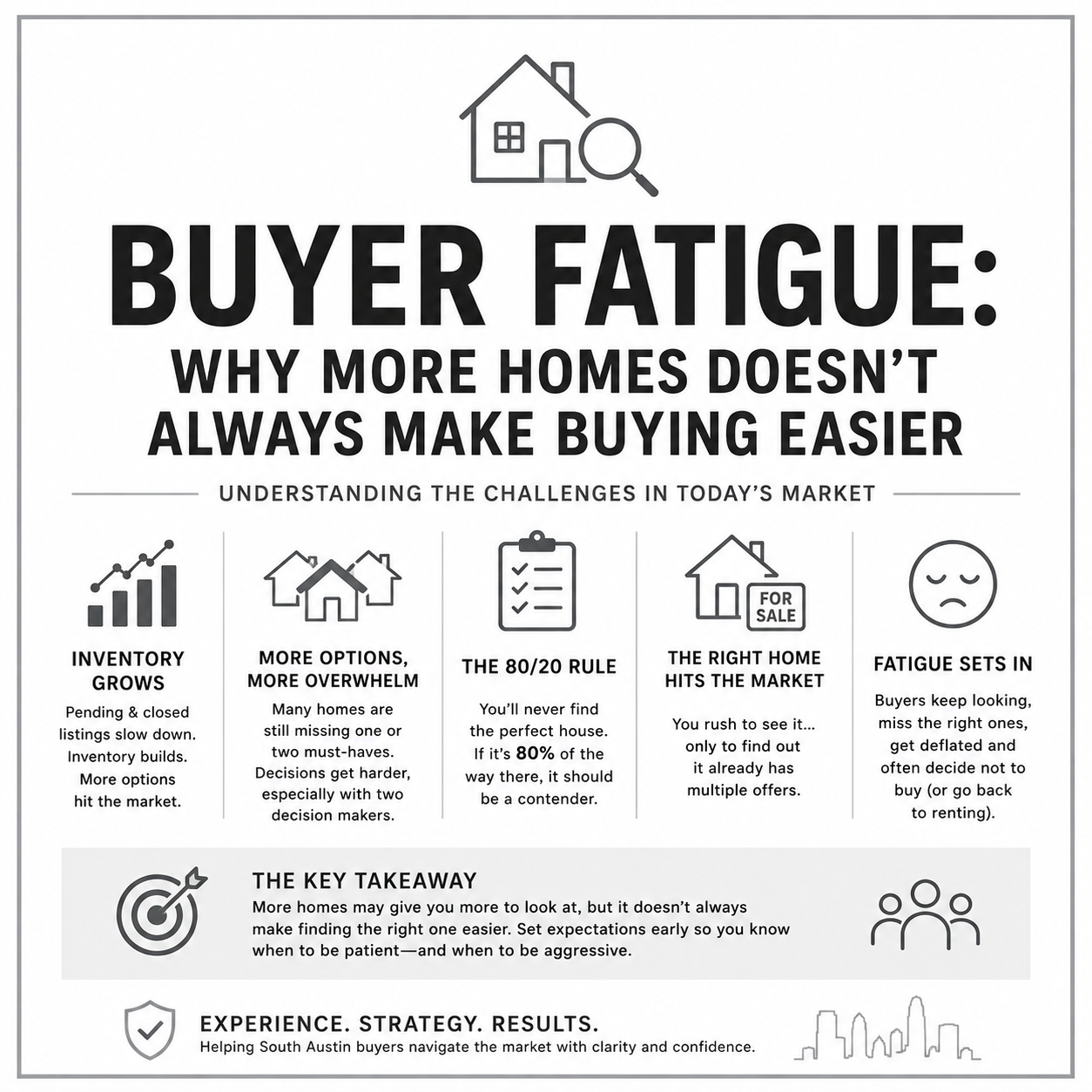
Buyer Fatigue: Why More Homes Doesn't Always Make Buying Easier
One of the biggest misconceptions in real estate is that more inventory automatically makes buying a home easier. It seems logical. If there are more homes on the market, buyers should have more choices and an easier time finding the right one. But after doing this for more than a decade, I can tell you that's often not how it plays out.
As inventory grows beyond four months, buyers begin experiencing something called buyer fatigue. I usually tell my clients to use the 80/20 rule. If a home checks about 80% of the boxes, it's probably worth serious consideration. The challenge is that once inventory starts piling up, most of the homes sitting on the market are there for a reason. One house has the giant backyard and updated kitchen but it's two stories when you wanted one. Another is beautifully remodeled but backs to a busy road. Another has the perfect layout but no bathtub in the primary bathroom and no practical way to add one. Individually, none of those compromises seem like a deal breaker. After you've looked at 30 or 40 homes, though, every compromise starts to feel bigger than it really is.
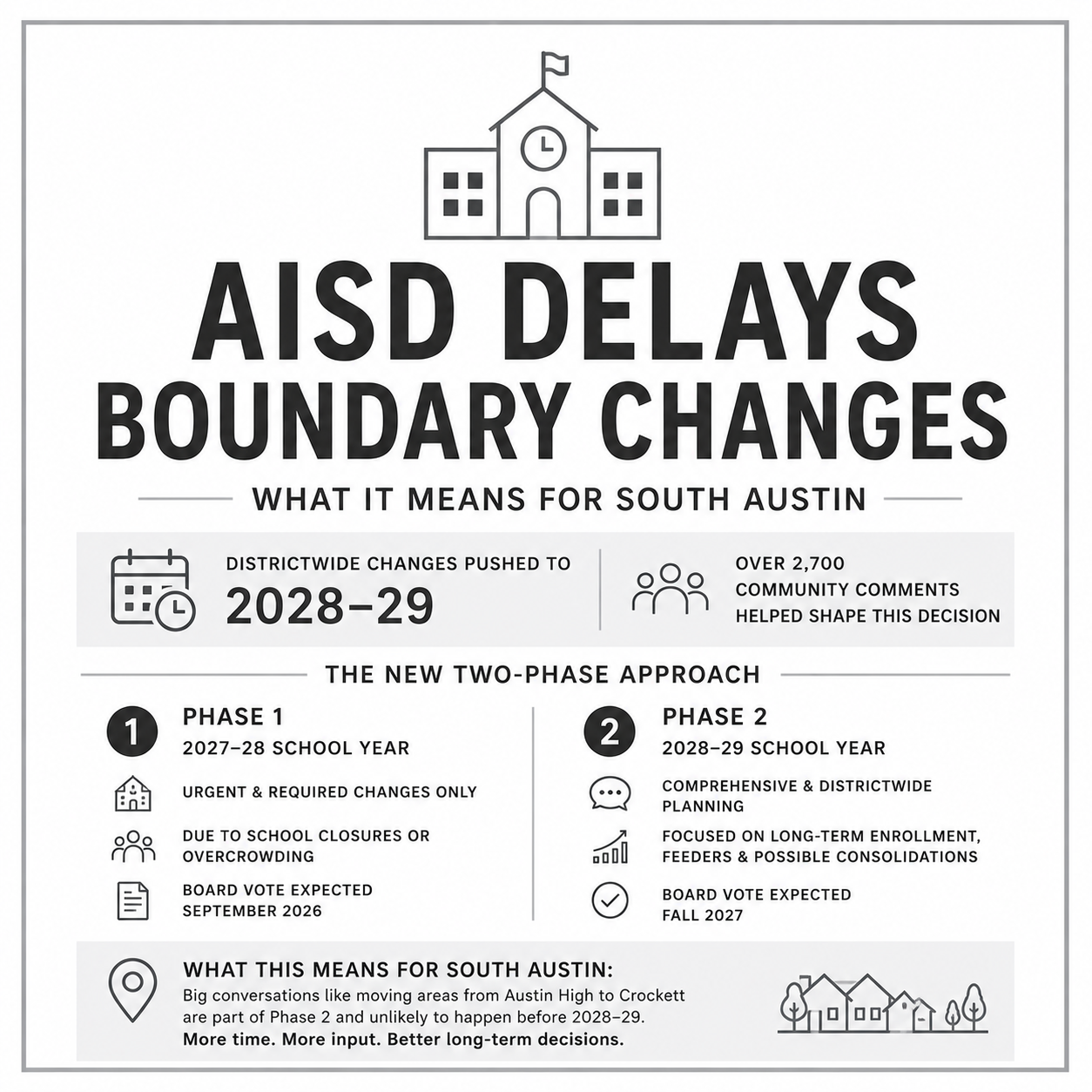
AISD Delays Major Boundary Changes: What It Means for South Austin
If you've been following the AISD boundary conversations over the past year, there was some meaningful news this week. Austin ISD announced that the large-scale districtwide boundary changes originally planned for the 2027-28 school year have been pushed back to 2028-29. Instead of redrawing attendance boundaries across the entire district all at once, AISD is moving to a two-phase approach. The first phase will focus only on urgent boundary changes caused by recent school closures and campuses that are growing so quickly they would otherwise need portable classrooms. The larger conversation about balancing enrollment across the district has officially been delayed.
From my perspective, this isn't all that surprising.

The Hidden Mold Problems We See in Southwest Austin Homes During Summer
Over the last few months, mold inspections have become a much bigger part of the real estate conversation. In fact, I recently sold a home in Southwest Austin that had to go through a full mold remediation before we could bring it to market. The reality is that mold is one of those things buyers are paying much closer attention to today than they were even a few years ago.
The first thing homeowners need to understand is that finding some mold in Texas is almost unavoidable. Mold is naturally present both outdoors and indoors, and small amounts enter our homes through doors, windows, HVAC systems, and other openings. That's completely normal. According to mold testing specialists, mold only becomes a problem when moisture allows it to grow and spread indoors. Without moisture, mold can't thrive.

Bowie High School Budget Update: What South Austin Families Should Know
The largest impact will be staffing reductions. Bowie will see its teaching staff decrease from 136 positions to 123 positions, although most of those reductions came through retirements and resignations rather than layoffs. According to Principal Brad Lancaster, only two staff members were directly affected and both were offered positions elsewhere within Austin ISD. Bowie will also lose one counselor position and see one assistant principal position reduced by 50%, which means existing staff will be carrying a heavier workload moving forward.
Students will likely notice some operational changes as well. Some teachers will see reduced planning periods, certain courses may be consolidated or eliminated, and AISD is moving secondary schools to a transportation hub model. That means students needing bus service may have to travel to a designated elementary school within the Bowie feeder pattern to catch a bus. Late activity buses are also being eliminated. Despite these changes, Bowie leadership emphasized that all major programs including athletics, fine arts, and career and technical education pathways remain in place for now.
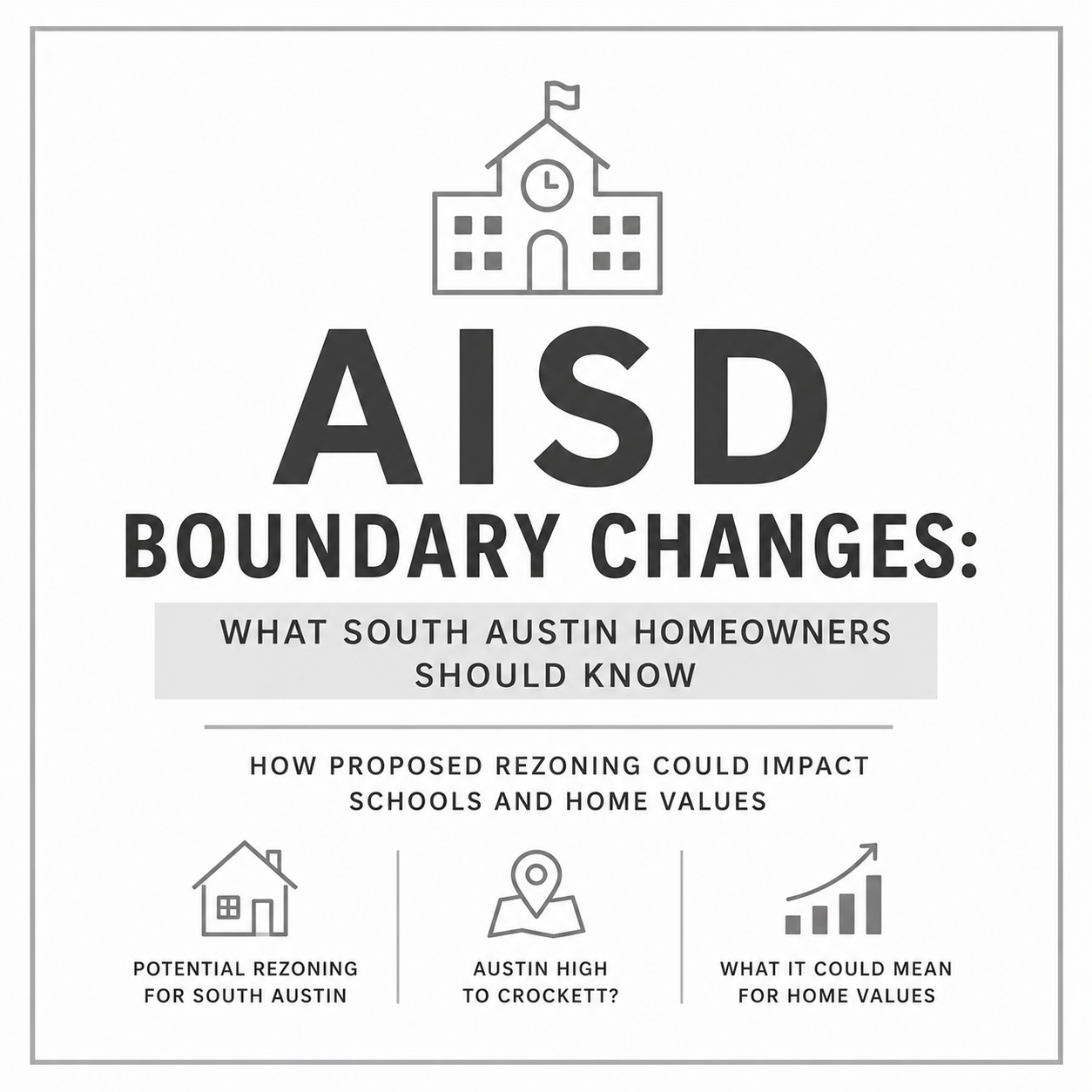
AISD Boundary Changes: Why South Austin Homeowners Should Pay Attention
If you've followed my blogs for any length of time, you've probably heard me say that schools drive the South Austin real estate market. That's why Austin ISD's ongoing boundary review process is worth paying attention to, whether you currently own a home or are considering buying one. Every few years, AISD evaluates attendance boundaries to balance enrollment across campuses as populations shift throughout the city. While no final decisions have been made, some of the proposed changes could have a meaningful impact on several Southwest Austin neighborhoods.

Austin ISD Budget Cuts: What Could This Mean for South Austin Real Estate?
Austin ISD recently announced a plan to address a staggering $181 million budget deficit, and while most of the headlines focus on schools and staffing, there could be some ripple effects for the South Austin housing market as well. Austin ISD cited several factors contributing to the shortfall, including declining property values, lower enrollment, rising operating costs, and years of state funding that failed to keep pace with inflation. To close the gap, the district is proposing hundreds of position reductions, larger class sizes at some campuses, shared support staff, transportation changes, and the sale of district-owned properties.

Does the Austin Housing Market Cool Off for Summer?
Austin summers are brutally hot… but does the housing market cool off too?
Historically, yes. The Austin real estate market is usually at its busiest during the spring, especially in neighborhoods where schools drive home values. Most families want to be settled before summer starts so they can prepare for the next school year. That means March, April, and May tend to be the frenzy months in South and Southwest Austin. Buyers are aggressively trying to get under contract while sellers time their listings to line up with the end of the school year and summer moves.
By the beginning of June, most of those school-driven buyers are already done.
That leaves the summer buyer pool looking a little different. In my experience, summer buyers are usually people whose leases are ending, families relocating to Austin for jobs, investors looking for opportunities on homes that have been sitting for a while, or homeowners preparing for bigger life transitions like downsizing or moving out of town after their kids leave the house. The urgency is still there for some buyers, but the overall pool tends to get noticeably smaller compared to spring.
78749 Market Update: The Spring Market Is Alive… But Buyers Are Picky
You can see this most clearly in neighborhoods like Maple Run, Legend Oaks, Circle C, and Village at Western Oaks. Renovated homes in desirable school paths are still commanding strong premiums. One of the wildest examples was a remodeled home in Bannockburn that closed at over $520 per square foot, which absolutely crushed the average price per square foot for the zip code. On the other end of the spectrum, there were multiple homes in the low $200 per square foot range that either needed updating, backed to less desirable locations, or simply missed the mark for today’s buyers. The spread between updated and outdated homes continues to widen.
The highest sale so far this year was in the J.W. Smith section of Western Oaks at $1.14M on Rolling Meadow Road. That sale reinforces something we continue to see over and over in Southwest Austin: larger lots, mature trees, and updated homes in established neighborhoods still carry major value. Meanwhile, some of the longer days on market came from homes that either started overpriced or required buyers to make too many compromises. There were several homes that sat 150 to 280 days before selling, which is a huge contrast compared to the homes that sold in under a week.

Surviving Summer in South Austin (Without Moving to Colorado)
When summer hits South Austin, staying cool stops being optional and turns into a full-time strategy.
If you’ve ever wondered how locals survive months of triple-digit heat without packing up and heading to Colorado, the answer is pretty simple: water, shade, and a steady rotation of cold treats. Places like Barton Springs and the Barton Creek Greenbelt aren’t just weekend activities this time of year—they’re lifelines. It’s that rare combination of being outside without feeling like you’re walking on the surface of the sun. And if you’ve been here long enough, you know the rule: early mornings and evenings are your friend unless you enjoy sweating through your personality.
Where you live actually plays a big role in how easy summer feels.
Neighborhoods like Circle C, Legend Oaks, Sendera, Shady Hollow, Avana, Meridian, Greyrock Ridge, and the J.W. Smith section of Western Oaks all have community pools. That alone can be a game changer. Being able to walk or drive a couple minutes to cool off in the middle of the day makes summer a whole lot more manageable. It’s one of those underrated perks that doesn’t show up on a listing sheet but absolutely impacts your day-to-day life.

New Construction in Austin: Dream Home or Expensive Headache?
New construction in Austin can look like the perfect solution but like most things in real estate, it depends.
If you’re buying new construction in Austin, you’re usually in one of two scenarios. Either you’re paying top dollar for a brand-new home in an established, highly desirable neighborhood… or you’re buying farther out, where builders are developing entire communities from scratch and offering incentives to get things moving. Both can make sense but they come with very different trade-offs.
The appeal of new construction is obvious.
It’s new. Everything feels clean, modern, and move-in ready. You get warranties on major systems like the foundation, roof, and mechanical components, which can provide peace of mind at least in the early years. The floor plans are designed for how people actually live today: open layouts, better storage, larger garages, and updated finishes. Even builder-grade materials tend to feel more modern than what you’ll find in older resale homes.